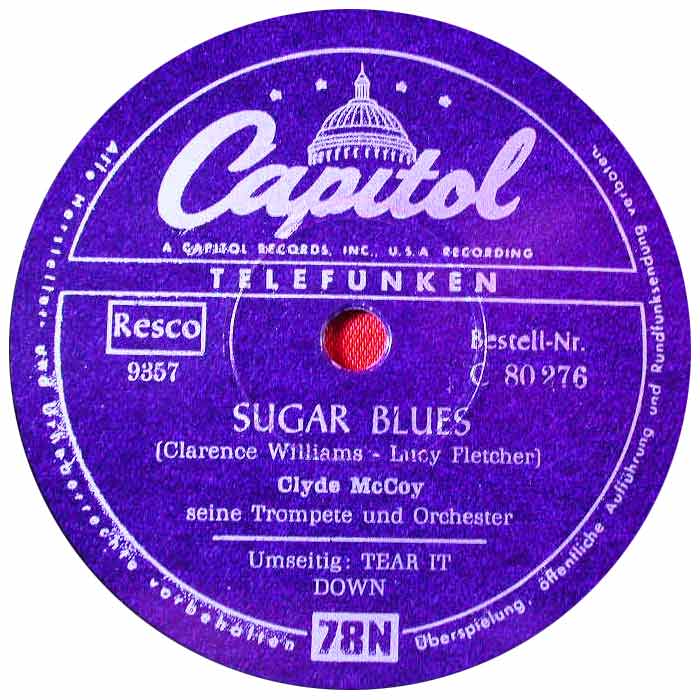
Jackets get swapped, inner sleeves migrate between records and stickers fall off over the years — but the label in the middle of the disc stays with it for life. It's the edition's printed ID card: who released the record, in which series, for which market and with which rights years. Once you can read it, you can pin down the exact edition in a couple of minutes, often without even tilting the disc towards a lamp.
The label is printed, the runout is etched
The label and the runout answer the same question — which edition is this? — but from opposite directions. The label is printed: it was designed and printed for an entire run and tells you what the company wanted to say about the edition. The runout is etched: the codes in the wax travel with the pressing tools and reveal the cut and the plant. The label is the quickest to read; the runout is the most reliable to trust. Use them in that order: the label narrows the candidates, the runout codes decide.
Label design dates the record
Record companies changed their label designs at regular intervals: logos were redrawn, colour schemes replaced, address and rights lines moved around. Every such change became a dividing line in time, and the collecting world has mapped them carefully — on Discogs, otherwise identical editions are often separated precisely by label variant. That's why the label photos on release pages are so valuable: compare your label against the images, not just the text. The ground rule is simple: a label design that didn't exist until long after the album's original year is immediate proof of a later pressing, however right the jacket looks. How that logic feeds into value is covered in the first pressing guide.
Anatomy of a catalogue number
The catalogue number normally appears both on the spine and on the label, and it's usually built from the same parts:
| Part | Example | What it tells you |
|---|---|---|
| Prefix | ABC | Company and series — at many labels also format or mono/stereo |
| Number | 123 | The position in the series; neighbours in number are often neighbours in time |
| Suffix | -A, -2 | Country, variant or format marker at some companies |
Two things to keep apart. First: the catalogue number identifies the edition, not the pressing — the same number can sit on pressings made decades apart. Second: catalogue number and matrix number are different things. The catalogue number is printed on the label and applies to the whole edition; the matrix number is etched in the runout and is usually the catalogue number plus side and cut codes.
The rights line: ℗ and ©
Along the edge or bottom of the label runs the rights text. ℗ covers the sound recording itself, © the printed material — jacket, photos, text. This is where the used market's most common misreading lives: the ℗ year is the year of the recording or the release, not of the pressing. A copy pressed twenty years later still carries the original's ℗ year, because the year follows the right, not the pressing date. Read the line like this: a ℗ year matching the original year says nothing about when your copy was pressed — but a later ℗ or © year than the original release's, common on remasters, is solid proof of a later edition.
"Made in" points to the market
"Made in Sweden", "Made in Germany", "Printed in England" — the country lines state where the disc was pressed and the jacket printed. It's often the fastest way to separate editions, because the same album with the same catalogue number was frequently pressed in several countries in parallel. For domestic artists, the home pressing is often the true original — a Polar-pressed Arrival is the original, while foreign pressings follow; more on that in the guide to Swedish pressings. A missing country line is a clue in itself, since requirements and habits varied between markets and eras.
Price marks and tax codes on older European records
Older European editions often carry small printed codes that have nothing to do with the music: price marks and tax codes that governed what the record could cost in the shops. Sweden is a good example — short letter or number codes on the label or the back of the jacket. They look cryptic, but they're useful in two ways: they confirm the copy was made for a specific market, and they help narrow the era, since the systems changed over time. If you find one on a record you assumed was an import, it's worth a second look.
Putting it all together on Discogs
- Write down the company name, catalogue number, rights years and country text — plus the label design in broad strokes.
- Look up the album on Discogs and filter the edition list by country and catalogue number.
- Compare your label against the candidates' label photos: logo version, text placement, colour.
- Down to two candidates? Then the runout decides — copy the matrix codes and compare field by field.
- In Rekord, the same journey is quicker: scan the jacket to identify the album, then open "Exact pressing" and type in the matrix number to get your specific edition with market data.
One label at a time, it builds a skill: you start seeing records as editions instead of titles. That's the eye that separates the digger who scores from everyone who flipped past the same crate — and the difference between paying original-pressing money for a repress and knowing exactly what you're holding.